
In this, the long delayed third installment of my series on Expressions of the Christian Faith in Narnia, I’ll be discussing the third book in C.S. Lewis’s Narnia trilogy entitled, The Voyage of the Dawn Treader. For Background, you can see the previous entries in this series: Introduction, Part One, Part Two.
The adventures of this third book take place after those of Prince Caspian. In this story, we once again see Edmund and Lucy Pevensie, but we also meet their cousin – the spoiled brat Eustace Scrubb. As this story begins, Edmund and Lucy are visiting with their aunt and uncle – Eustace’s parents, when suddenly they are sucked into the world of Narnia. Immediately, the children find themselves in the ocean, only to be rescued by the nearby Narnian vessel, The Dawn Treader. Aboard the vessel they meet none other than King Caspian X, their friend from their previous visit to Narnia.
The children soon discover that Caspian is on a voyage to explore the sea and search out seven lost Nobles who had been loyal to his father. The Dawn Treader is the first of Narnia’s sailing vessels since the time when the Pevensies had ruled Narnia centuries before. Along the journey, the friends encounter many islands, reclaiming some and discovering others.
There are a few themes which Lewis discusses in the book, but perhaps one of the most central themes is that of sin and redemption. Eustace learns a valuable lesson and is changed, from a spoiled, bullying, rotten, greedy person, into a truly good and decent human being.
One of the first places that the Narnians visit are the Lone Islands, which are the rightful domain of the King of Narnia. It is here that Caspian and the others encounter one the first of the lost Nobles. It is also here that he saves them from slavers who have infested the islands. The lord tells Caspian that the governor of the islands will probably not be happy to see the king, so they devise a plan whereby Caspian and the others land on the main island where they parade through the city up to the governor’s palace. Here, a time of reckoning takes place for the governor and his men.
When Caspian meets the governor, Gumpas, it is clear that the man has forgotten that it is he who serves the King. He has become pompus and enthralled by his own power. When Gumpas protests at the King’s reminders of unpaid tribute and refuses to take responsibility for the abolition of slavery in the Islands, Caspian deposes him, replacing him with the loyal Lord Bern, whom he makes Duke of the Lone Islands.
This episode is a picture of the reckoning which will take place at the end of the age. The Bible tells that the rightful King of all creation will return, and this time He will not permit Himself to be refused. Instead He shall judge each of us. We all will be called to give an account of what we have done on that day of reckoning.
As the Dawn Treader makes its way eastward over the sea, the crew encounters a number of islands. The events occurring on the ship are told both by the narrator, and occasionally from the selfish perspective of Eustace via his diary. One of the islands that the crew encounters serves as a location for repairs and resupplying the ship. As the crew is hard at work on this seemingly uninhabited island, Eustace steals away to avoid the work. He becomes lost and encounters an old dragon just as it breathes its final breaths. He discovers its cave and falls asleep amidst the pile of loot. However, upon waking, Eustice soon discovers that he himself has become a dragon! Finally, he must reveal himself to his friends. He cannot speak, but communicates his true identity to them by writing on the sand of the beach.
For many days Eustace lives as a dragon. He is miserable and outcast from the group. He finds ways to make himself useful, but he behaves, according to his dragonish nature, in ways that disgust even himself. Eustace longs to be a boy again, but through this time he recognizes how badly he had treated everyone around him, and that they merely had his best interests at heart.
One night Eustace meets Aslan, who invites him to a small pool in a distant clearing. Aslan tells Eustace to disrobe and bathe. Eustace tries in futility to remove the dragonish scales, discovering layer upon layer of them covering his body. Finally, he submits to Aslan, who removes the scales and washes him, making him a boy again. Only this time, Eustace is a new person. He has been reborn, changed forever by Aslan.
I find this part of the story to be particularly moving. I did not always, but more and more I see that I am Eustace. I see how "dragonish" I can be, but God cuts through all of that in a unique way. When we allow Him to, He can clean us and change us. And like Eustace, once we've encountered God, we are changed for the best.
The company encounters a number of other islands. One of these they name "Deathwater Island," for it is here that they discover a pool which has the power to turn anything its water touches to gold. As they confront their own greed, they discern the golden figure of a swimmer at the bottom of the pool. Here, they realize they have found another of the lost nobles. They also learn a valuable lesson of the destructive nature of greed.
On another of the islands, the crew of the Dawn Treader encounters a race of invisible people who claim to be under the spell of the magician who rules the island. As the friends so find out, the magician is not evil, rather he has the best interests of the other inhabitants at heart, only they are too simpleminded and stubborn to realize this. Still as a loving master, he cares for them in after a paternal fashion. On this island the children, especially Lucy, learn quite a bit. However, one of the most significant things here is the relationship of the magician with the simple servants. While he, somewhat symbolic of God, cares for them and wants what is best for them, they are dissatisfied and rebel against him -- to their own detriment. While they are humorous and obviously quite stupid, sometimes we can identify with them.
The next island the crew encounters is a dark island, where they take a lone stranger aboard. He is quite insistent that they must not go ashore, for this is an island where nightmares become real. As they turn and row with all their might away from the island, they learn that this is yet another of the lost nobles of Narnia.
The final island on their journey is where they find the final three nobles; having discovered the first on the lone islands, the second as the dying dragon, the third turned to gold, and the fourth rescued from the dark island. When they encounter the final three, the men are seated at a magic table, deep in an enchanted sleep. The master of the Island is Ramandu, who had once been a star, but then grew old and descended to this island. Each day he and his beautiful daughter sing as the sun rises and a flock of birds come from the sun bearing a fire-berry which they give to Ramandu and he grows younger until one day he will be a baby and once again return to the sky as a star. Each evening on this island a magical banquet appears upon the table-- Aslan's table. Upon the table lies a stone knife, which they learn to be the same knife with which the White Witch killed Aslan. It has been brought here to be "kept in honour while the world lasts."
The friends learn that the three nobles sleep because they had taken up the knife against one another in a disagreement many years ago. In order to rescue the sleepers from their sleep, the crew must continue east to the end of the world, and leave one of their own, then return.
Caspian falls in love with the daughter of Ramandu, and promises to return for her. The Dawn Treader continues to the edge of the world, encountering mer-people, beautiful flowers floating on the sea's surface, and discovering that the water at the end of the world is a kind of "living water," which they drink and are sustained.
At long last they come to the end of the world. Here it is Reepicheep the mouse who volunteers for the adventure of traveling past the end of the world, to "Aslan's country." He and the children part ways with the crew, and go their separate ways. The children find that they are able to walk, for the water is shallow here, to a strange place where they encounter a lamb, who offers them a breakfast of fish (cf. John 21) and then turns into a lion -- Aslan. He reveals that He is known by another name in our world (i.e., God) and that Edmund and Lucy will not return to Narnia. After this, He sends the children home.
Especially toward the end of the book, Lewis's symbolism of God and Aslan are more and more clear. The lion who is also a lamb is a clear reference back to the God of the Bible, who Himself is portrayed as both. It is here that Lewis, via Aslan, reveals at least part of his purpose with the books. Aslan says, "I am [there]. But there I have another name. You must learn to know me by that name. This was the very reason why you were brought to Narnia, that by knowing me here for a little, you may know me better there." Indeed, Lewis sums up the purpose of his books, namely, that readers might learn about God by learning about Aslan and Narnia.
Showing posts with label books. Show all posts
Showing posts with label books. Show all posts
Friday, December 14, 2007

Monday, December 03, 2007
The Most Wonderful Time of the Year
(Side note: I've been away from my Narnia series for some time now, and hope to pick that back up with greater regularity as the semester comes to an end soon.)
This year is the first time that my wife and I have really observed Advent. This will be our second Christmas since we've been married, but I never celebrated Advent before either. It seems sad to me that so few Christians in America (and especially those of us from the Free Church-read "baptist"-tradition) today seem to know anything about the Ecclesiastical Calendar.
Perhaps the reason for this is because we (Baptists) have rejected a number of the liturgical customs, and in some cases the more disagreeable or even unorthodox doctrines that have tended to come along with them. However, I think that there can be some merit to customs such as Advent and some other Christian seasons.
The beauty of Advent is that it directs our focus toward Jesus, both His incarnation (His birth on Christmas) and His imminent return. For me, it's so easy to get caught up in the "hustle and bustle" of the Christmas season. I like to take time to re-focus on Jesus and to think about and celebrate His birth, and the precious gift that He is to all mankind.
Yesterday was the first Sunday of Advent, and my wife and I have started going through a book about Advent, entitled Celebrate Christmas: And the Beautiful Traditions of Advent. Last year and the year before I began a search for some good resources for reading and devotional times leading up to Christmas. This one is not bad from what I've seen, and actually it one of the better resources I've run across, but the trouble is the scarcity of material. Perhaps that's not such a bad thing. There are far too many Christian books on other topics (many of which I'm simply not that interested in).
We'll be lighting the candles in our Advent Wreath soon. I'd love to hear your thoughts on the season of Advent. Do you celebrate it? Are there any books/resources that you use and/or recommend?
This year is the first time that my wife and I have really observed Advent. This will be our second Christmas since we've been married, but I never celebrated Advent before either. It seems sad to me that so few Christians in America (and especially those of us from the Free Church-read "baptist"-tradition) today seem to know anything about the Ecclesiastical Calendar.
Perhaps the reason for this is because we (Baptists) have rejected a number of the liturgical customs, and in some cases the more disagreeable or even unorthodox doctrines that have tended to come along with them. However, I think that there can be some merit to customs such as Advent and some other Christian seasons.
The beauty of Advent is that it directs our focus toward Jesus, both His incarnation (His birth on Christmas) and His imminent return. For me, it's so easy to get caught up in the "hustle and bustle" of the Christmas season. I like to take time to re-focus on Jesus and to think about and celebrate His birth, and the precious gift that He is to all mankind.
Yesterday was the first Sunday of Advent, and my wife and I have started going through a book about Advent, entitled Celebrate Christmas: And the Beautiful Traditions of Advent. Last year and the year before I began a search for some good resources for reading and devotional times leading up to Christmas. This one is not bad from what I've seen, and actually it one of the better resources I've run across, but the trouble is the scarcity of material. Perhaps that's not such a bad thing. There are far too many Christian books on other topics (many of which I'm simply not that interested in).
We'll be lighting the candles in our Advent Wreath soon. I'd love to hear your thoughts on the season of Advent. Do you celebrate it? Are there any books/resources that you use and/or recommend?
Monday, November 12, 2007
Expressions of the Christian Faith in Narnia – Part 2
After a hiatus due to school work and life in general, now I continue my series on the Christian themes in C.S. Lewis’s The Chronicles of Narnia.
In Part One of the series, I outlined the story of book one, The Lion, the Witch, and the Wardrobe and I attempted to highlight some of the spiritual themes of the first book in the Narnia series. This week I’ll look at book two – Prince Caspian. It seems especially timely that I should be discussing this series as the buzz is growing about another children’s series entitled His Dark Materials. The movie version of the first book in that series, The Golden Compass has gotten a lot of discussion of late.
Of the other, atheistic, series I have little to say now. However, Kevin Bussey has a brief discussion of the topic here. I will say, however, that I find it interesting that Nicole Kidman, herself a catholic, would be involved with this movie, but then what do I know about movies and moviemakers? Having said my piece, let us move on to Prince Caspian.
In this, the second Narnia book, the Pevensie children return to the magical land of Narnia to find that hundreds of years have passed, while only a few months have gone by in our world. Their beloved land has been taken over by the Telmarines, who have sought to remove every vestige of magic from the land. They fear the talking animals and magical creatures, and so they have driven them into hiding.
Among these Telmarines is a young man named Caspian whose uncle, Miraz, the king has raised him. The boy, Caspian, grows up under the tutelage of a Doctor Cornelius, who, unbeknownst to the king, is part dwarf. He reveals to Caspian the truth about Narnia, and that it is a magical land, and was once inhabited by the magical creatures. Caspian has a fascination with the “old Narnia” and longs to learn more of the old days. As he learns more, he also finds that Miraz is a usurper. His father, King Caspian IX, was the ruler before his death, and since that time Miraz had proclaimed himself king. This becomes crucial to Caspian when he learns that his aunt, the Queen has given birth to a son – and so he must flee into exile in order to save his own life.
As Caspian enters the mountains, he encounters the remnants of the “old Narnians” – the talking beasts and magical creatures. They recognize him as the true king and form a resistance.
Meanwhile the Pevensie children return to Narnia and encounter one of the old Narnians, who tells them of Caspian. They set out on their way to meet up with Caspian and his army, with many trials along the way. It is this part of the story which deals with the matter of faith. As they journey to meet Caspian, they lose their way. Lucy, however sees Aslan, while the other children cannot. She reveals that He wants them to follow Him. As the others believe her, putting their faith in Aslan, they are able to see Him too. Thus, in the story we recognize a critical spiritual truth that, believing is seeing.
Meanwhile, Caspian and his advisors must decide if they will trust in Aslan to send them aid in their cause, or whether they will turn to dark magic. Thankfully, they make the right decision, just as the Pevensies arrive. Perhaps the biggest of the issues that faces the characters in this book is the struggle of faith. The Telmarines generally have made a decision not to believe in Aslan or in “Old Narnia,” as a result they live their lives in a decidedly un-magical fashion. However, so many of the “old Narnians” themselves have lost faith in Aslan. He has not been seen in Narnia for many years, and so some have decided not to believe in Him.
The action comes to a climax in a single-combat match where Miraz faces off against Peter. The scene is somewhat reminiscent of a David and Goliath type conflict, pitting a man, Miraz, against a boy, Peter. In the end, Peter defeats Miraz, but it is the Userper’s own treacherous lieutenants who kill him. A battle ensues and the Narnians, let by Caspian, Peter, and Edmund are soon joined by a second Narnian army, reawakened and led by Aslan himself. The Telmarines are defeated and Caspian is recognized as the rightful ruler of Narnia.
As a result of the battle, Narnia is reclaimed by the magical creatures who had inhabited it. Curiously, Lewis introduces a number of pagan mythological figures, namely Baccus and Dionysus. (In this we can be certain that he is no Baptist). However, each of the gods introduced recognizes Aslan as superior. I believe that this is one of several cases where Lewis chooses to use fantastic or mythological elements to advance or enhance his story, but where they serve no real theological purpose.
At the outset I tried to make it clear that these books are not theology books, nor are they to be taken for gospel. They are stories, but they do have a number of elements, as I am trying to show, which are Christian in nature and give the books themselves a Christian bent.
As the story draws to a close, Aslan questions Caspian, much as God comes to Solomon in 1 Kings 3. Aslan asks Caspian if he feels worthy to be king, to which Caspian replies that he is only a boy. Aslan blesses him, acknowledging that his humility is a great virtue and giving him the promise (as God gave to David) that his children would always sit on the throne of Narnia.
Finally, Aslan shows mercy. He shows mercy to the mouse, Reepicheep, by restoring his tail (a mouse’s glory), which had been cut off in the battle. In addition Aslan reveals that the Telmarines were originally from our world. They had entered into Narnia from a magic cave on an island which their ancestors (pirates) had discovered. Aslan provides an opportunity for those who wish to return to that island. And he sends the children back to England.
In Part One of the series, I outlined the story of book one, The Lion, the Witch, and the Wardrobe and I attempted to highlight some of the spiritual themes of the first book in the Narnia series. This week I’ll look at book two – Prince Caspian. It seems especially timely that I should be discussing this series as the buzz is growing about another children’s series entitled His Dark Materials. The movie version of the first book in that series, The Golden Compass has gotten a lot of discussion of late.
Of the other, atheistic, series I have little to say now. However, Kevin Bussey has a brief discussion of the topic here. I will say, however, that I find it interesting that Nicole Kidman, herself a catholic, would be involved with this movie, but then what do I know about movies and moviemakers? Having said my piece, let us move on to Prince Caspian.
In this, the second Narnia book, the Pevensie children return to the magical land of Narnia to find that hundreds of years have passed, while only a few months have gone by in our world. Their beloved land has been taken over by the Telmarines, who have sought to remove every vestige of magic from the land. They fear the talking animals and magical creatures, and so they have driven them into hiding.
Among these Telmarines is a young man named Caspian whose uncle, Miraz, the king has raised him. The boy, Caspian, grows up under the tutelage of a Doctor Cornelius, who, unbeknownst to the king, is part dwarf. He reveals to Caspian the truth about Narnia, and that it is a magical land, and was once inhabited by the magical creatures. Caspian has a fascination with the “old Narnia” and longs to learn more of the old days. As he learns more, he also finds that Miraz is a usurper. His father, King Caspian IX, was the ruler before his death, and since that time Miraz had proclaimed himself king. This becomes crucial to Caspian when he learns that his aunt, the Queen has given birth to a son – and so he must flee into exile in order to save his own life.
As Caspian enters the mountains, he encounters the remnants of the “old Narnians” – the talking beasts and magical creatures. They recognize him as the true king and form a resistance.
Meanwhile the Pevensie children return to Narnia and encounter one of the old Narnians, who tells them of Caspian. They set out on their way to meet up with Caspian and his army, with many trials along the way. It is this part of the story which deals with the matter of faith. As they journey to meet Caspian, they lose their way. Lucy, however sees Aslan, while the other children cannot. She reveals that He wants them to follow Him. As the others believe her, putting their faith in Aslan, they are able to see Him too. Thus, in the story we recognize a critical spiritual truth that, believing is seeing.
Meanwhile, Caspian and his advisors must decide if they will trust in Aslan to send them aid in their cause, or whether they will turn to dark magic. Thankfully, they make the right decision, just as the Pevensies arrive. Perhaps the biggest of the issues that faces the characters in this book is the struggle of faith. The Telmarines generally have made a decision not to believe in Aslan or in “Old Narnia,” as a result they live their lives in a decidedly un-magical fashion. However, so many of the “old Narnians” themselves have lost faith in Aslan. He has not been seen in Narnia for many years, and so some have decided not to believe in Him.
The action comes to a climax in a single-combat match where Miraz faces off against Peter. The scene is somewhat reminiscent of a David and Goliath type conflict, pitting a man, Miraz, against a boy, Peter. In the end, Peter defeats Miraz, but it is the Userper’s own treacherous lieutenants who kill him. A battle ensues and the Narnians, let by Caspian, Peter, and Edmund are soon joined by a second Narnian army, reawakened and led by Aslan himself. The Telmarines are defeated and Caspian is recognized as the rightful ruler of Narnia.
As a result of the battle, Narnia is reclaimed by the magical creatures who had inhabited it. Curiously, Lewis introduces a number of pagan mythological figures, namely Baccus and Dionysus. (In this we can be certain that he is no Baptist). However, each of the gods introduced recognizes Aslan as superior. I believe that this is one of several cases where Lewis chooses to use fantastic or mythological elements to advance or enhance his story, but where they serve no real theological purpose.
At the outset I tried to make it clear that these books are not theology books, nor are they to be taken for gospel. They are stories, but they do have a number of elements, as I am trying to show, which are Christian in nature and give the books themselves a Christian bent.
As the story draws to a close, Aslan questions Caspian, much as God comes to Solomon in 1 Kings 3. Aslan asks Caspian if he feels worthy to be king, to which Caspian replies that he is only a boy. Aslan blesses him, acknowledging that his humility is a great virtue and giving him the promise (as God gave to David) that his children would always sit on the throne of Narnia.
Finally, Aslan shows mercy. He shows mercy to the mouse, Reepicheep, by restoring his tail (a mouse’s glory), which had been cut off in the battle. In addition Aslan reveals that the Telmarines were originally from our world. They had entered into Narnia from a magic cave on an island which their ancestors (pirates) had discovered. Aslan provides an opportunity for those who wish to return to that island. And he sends the children back to England.
Thursday, October 25, 2007
Expressions of the Christian Faith in Narnia - Part One
Today I’m continuing a series I announced last week. The series is entitled “Expressions of the Christian Faith in Narnia.” Last week I discussed some of the difficulties with such a series, but I hope to bring out some meaningful insights in this and future articles.
In this first installment I’m looking at book one (although the books have been re-ordered in recent versions of the series, this was still the first book): The Lion, the Witch, and the Wardrobe.
In this book we encounter the four Pevensie children, who are sent to live in the British countryside during the “Battle of Britain” to avoid the Blitz. The children--Peter, Susan, Edmund, and Lucy – move into the home of old Professor Digory Kirke (perhaps a representation of Lewis himself, or one of his own mentors).
While living with the Professor, they encounter a magic wardrobe, through which they gain entrance into the magical land of Narnia. Now, if you’re reading I am going to assume that you’ve read the books, and will feel free to give away some key plot points. When they enter Narnia they learn that the land is being ruled by the cruel, usurping White Witch, who has caused the land of Narnia to exist in perpetual winter (but never Christmas). This White Witch, in most respects represents Satan, whom the Bible refers to as “the prince of this world” (and other similar titles). The true King of Narnia is Aslan, the son of the Emperor beyond the Sea (recognize him as representative of Jesus, who is the Son of God). Aslan has not been in Narnia for many years, though the residents of His lands expect his return and wait with great anticipation (much like the Jews look for the return of the Messiah). There also exists a prophesy that foretells the coming of two sons of Adam, and two Daughters of Eve, who will come to claim the throne of Narnia.
Once they enter Narnia, however, the children realize that their brother, Edmund, has (like Judas) betrayed his brother and sisters to the White Witch. He has done this because the Witch gives him Turkish Delight and offered him the promise of ruling over Narnia at her side. This series of events can be all too familiar for some. While we may not be giving up our right to a throne, or delivering our own flesh and blood to an evil witch, perhaps we have passed up some good things, or exchanged God’s blessings for temporal pleasures. Of course, we know – and Edmund soon finds out—that the Witch has no intention of making good on her promise.
The children are saved, however, by the return of Aslan. At His return, the winter begins to melt away (but not before Father Christmas comes). Aslan’s reappearance forces a confrontation with the Witch. Recognizing (with fear) Aslan’s power, the Witch plays her trump card. She informs Aslan that according to the laws of Narnia, she has rights to the blood of traitors (i.e. Edmund). Aslan recognizes this and purchases Edmund’s freedom by offering Himself in exchange. As Christians we recognize that we were like Edmund – sinners, and were guilty before God. However, God chose to send His only Son—Jesus to die in our place in order to pay the penalty.
That night, Aslan, accompanied by Susan and Lucy, has His own Gethsemane experience. Afterward He proceeds to meet the Witch as the pre-assigned location – the Stone Table. Then, as Susan and Lucy look on from their hiding place, the Witch and her henchmen bind Aslan, shave His mane, and mock him. At this the girls recognize that Aslan, had He so chosen, could have stopped them, but He does not. Finally, the Witch takes her dagger and kills Aslan.
The Witch rejoices at her victory and rallies her army for the final showdown with Aslan’s army, now under the leadership of Peter. Yet, as the dawn comes, the girls (mourning Aslan’s death) recognize that He is not on the table, but has Risen from the Dead! This, of course is a direct parallel to the death, burial, and resurrection of Jesus Christ). Aslan then frees the captives of the Witch and returns to lead His forces to victory, and kills the Witch.
Afterwards Aslan sets the four children upon the thrones at Cair Paravel, from which they reign in peace over Narnia for many years. Then one day they happen upon the place from which they entered Narnia and all tumble out of the wardrobe to realize that in our world, no time has passed at all.
This story, while much of it is simply a fantastic children’s story, contains great themes of redemption, good versus evil, and tells the story of Christ’s mission to redeem us, His people. We are all Edmund. All of us have done something that makes us guilty before God, and as a result we must pay the price (death – viz, Romans 6:23). However Jesus, like Aslan in the story, came and offered Himself as a sacrifice on our behalf. Neither death nor Satan defeated Him, rather He defeated them, just as Aslan defeats the Witch in the story. The children recognize, just as you and I should, that Aslan (in our case God) rewards those who are His and blesses them. You and I, if we accept Christ’s sacrifice, and give ourselves to Him, will receive blessings in Eternity as we spend it with Him in Heaven.
In this first installment I’m looking at book one (although the books have been re-ordered in recent versions of the series, this was still the first book): The Lion, the Witch, and the Wardrobe.
In this book we encounter the four Pevensie children, who are sent to live in the British countryside during the “Battle of Britain” to avoid the Blitz. The children--Peter, Susan, Edmund, and Lucy – move into the home of old Professor Digory Kirke (perhaps a representation of Lewis himself, or one of his own mentors).
While living with the Professor, they encounter a magic wardrobe, through which they gain entrance into the magical land of Narnia. Now, if you’re reading I am going to assume that you’ve read the books, and will feel free to give away some key plot points. When they enter Narnia they learn that the land is being ruled by the cruel, usurping White Witch, who has caused the land of Narnia to exist in perpetual winter (but never Christmas). This White Witch, in most respects represents Satan, whom the Bible refers to as “the prince of this world” (and other similar titles). The true King of Narnia is Aslan, the son of the Emperor beyond the Sea (recognize him as representative of Jesus, who is the Son of God). Aslan has not been in Narnia for many years, though the residents of His lands expect his return and wait with great anticipation (much like the Jews look for the return of the Messiah). There also exists a prophesy that foretells the coming of two sons of Adam, and two Daughters of Eve, who will come to claim the throne of Narnia.
Once they enter Narnia, however, the children realize that their brother, Edmund, has (like Judas) betrayed his brother and sisters to the White Witch. He has done this because the Witch gives him Turkish Delight and offered him the promise of ruling over Narnia at her side. This series of events can be all too familiar for some. While we may not be giving up our right to a throne, or delivering our own flesh and blood to an evil witch, perhaps we have passed up some good things, or exchanged God’s blessings for temporal pleasures. Of course, we know – and Edmund soon finds out—that the Witch has no intention of making good on her promise.
The children are saved, however, by the return of Aslan. At His return, the winter begins to melt away (but not before Father Christmas comes). Aslan’s reappearance forces a confrontation with the Witch. Recognizing (with fear) Aslan’s power, the Witch plays her trump card. She informs Aslan that according to the laws of Narnia, she has rights to the blood of traitors (i.e. Edmund). Aslan recognizes this and purchases Edmund’s freedom by offering Himself in exchange. As Christians we recognize that we were like Edmund – sinners, and were guilty before God. However, God chose to send His only Son—Jesus to die in our place in order to pay the penalty.
That night, Aslan, accompanied by Susan and Lucy, has His own Gethsemane experience. Afterward He proceeds to meet the Witch as the pre-assigned location – the Stone Table. Then, as Susan and Lucy look on from their hiding place, the Witch and her henchmen bind Aslan, shave His mane, and mock him. At this the girls recognize that Aslan, had He so chosen, could have stopped them, but He does not. Finally, the Witch takes her dagger and kills Aslan.
The Witch rejoices at her victory and rallies her army for the final showdown with Aslan’s army, now under the leadership of Peter. Yet, as the dawn comes, the girls (mourning Aslan’s death) recognize that He is not on the table, but has Risen from the Dead! This, of course is a direct parallel to the death, burial, and resurrection of Jesus Christ). Aslan then frees the captives of the Witch and returns to lead His forces to victory, and kills the Witch.
Afterwards Aslan sets the four children upon the thrones at Cair Paravel, from which they reign in peace over Narnia for many years. Then one day they happen upon the place from which they entered Narnia and all tumble out of the wardrobe to realize that in our world, no time has passed at all.
This story, while much of it is simply a fantastic children’s story, contains great themes of redemption, good versus evil, and tells the story of Christ’s mission to redeem us, His people. We are all Edmund. All of us have done something that makes us guilty before God, and as a result we must pay the price (death – viz, Romans 6:23). However Jesus, like Aslan in the story, came and offered Himself as a sacrifice on our behalf. Neither death nor Satan defeated Him, rather He defeated them, just as Aslan defeats the Witch in the story. The children recognize, just as you and I should, that Aslan (in our case God) rewards those who are His and blesses them. You and I, if we accept Christ’s sacrifice, and give ourselves to Him, will receive blessings in Eternity as we spend it with Him in Heaven.
Thursday, October 18, 2007
Expressions of the Christian faith in Narnia - Intro
Today I'm starting on a new series of posts that I will continue working on periodically. I invite your input, opinions, and thoughts on these matters.
First off, I want to start by saying that I have never been a big fan of the perennial fad books that seek to “find God” in whatever the latest thing may happen to be. I used to work in a Christian bookstore and came to despise the blatant commercialism that often goes on in the realm of Christian media. Several years ago, I remember nearly losing it when I encountered a devotional entitled Walking with Frodo. I don’t mean to slam the author of this book or others, but I do resent the system that has been built around claiming the latest pop culture item (cf. “The Gospel According to [insert pop culture item here]).” There was a time, not too long ago, when C.S. Lewis and The Chronicles of Narnia were that fad icon. And I have a feeling that they will come back to the front shelf of Christian stores everywhere when another Narnia movie comes out.
One of the superficial benefits of reading children’s stories like these was that they provided me an opportunity to practice the “oral interpretation” skills that I had been learning about in my preaching class with Dr. David Allen. (SIDE NOTE: The Bible is far more important a book than any other, and after listening to some books on tape, I realized that I much preferred listening to those where the reader made the text come alive. Surely preachers of the gospel ought to cultivate that skill in the reading of the holy Scriptures.) I did enjoy getting to practice some of the voices, and it gave me a great chance to spend time with my wife – reading together is a great activity.
However, some of the deeper insights I gained had to do with the spiritual truths that Lewis actively conveys through these stories. He conveys many of the great themes of the Bible – redemption, Christ’s substitutional atonement, sanctification, forgiveness, the Lordship of Christ, child-like faith, the nature of sin and grace, Creation, the Fall, and the Return of Christ just to name a few. In some upcoming posts I hope to discuss some of these themes, recognizing that these are fictional books, but at the same time looking at these often parabolic stories through a Biblical worldview. The allegories are never perfect, but then, none ever are. Still, re-reading these books as a seminary student, I was able to pick up on some of the spiritual facets of the books that I had previously overlooked or forgotten about.
Over the coming weeks, as I get some of that ever-elusive "free time," I intend to post about some of these spiritual themes that we find in these much-loved children's stories.Monday, October 08, 2007
Review: Communicating for a Change
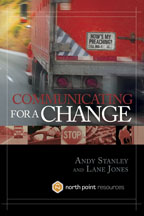
I recently finished a great read, one which I highly recommend to anyone who preaches or speaks in public. The book of which I speak is Andy Stanley's Communicating for a Change.
The book itself is divided into two sections. The first section, written by co-author Lane Jones, is a modern day parable about a pastor who encounters a old trucker who teaches him the principles of effectively communicating. These principles are the foundation of Stanley's own method.
The second section of the book is from Stanley himself about his preaching method. Throughout this part, Stanley argues the case for his method, which revolves around focusing on a single point. He argues that many preachers today try to cram too much into their messages, and as a result the audience gets information, but no actual change occurs in their lives.
One of the best things about the book is that the reader gets to learn some of Andy Stanley's personal communication secrets. He takes on the issues around the preacher's use of notes, solid introductions and conclusions, finding your own effective style, and the authority of scripture. I highly recommend this book, but I must warn readers that only those who are willing to consider making some changes to their way of preaching should bother to read it. If you are willing to learn, I've no doubt you'll gain something from this book. It will certainly go on my shelf as a favorite.
I give this book 4.75 out of 5 stars.
Thursday, September 20, 2007
Tired of the Guilt
In the news recently, the latest case for the 24-hour news media has been the case of the so-called "Jena Six." Since I listen to the radio and watch tv, I feel that I am at least moderately (if not severely) informed about the case. As if this weren't enough, we have Jessie Jackson, Al Sharpton and a number of other "civil rights" leaders stirring the pot on the issue and milking the situation for all it's worth.
See, that's what bothers me about cases like this. And I don't think I'm the only one. I believe that so many Americans, and especially young white Americans are tired of the load of guilt that Jackson, Sharpton, and others attempt to foist upon us every time there's an issue to which they devote themselves as they make it a "race issue." To tell the truth, the more I learn about Jena, the less it all makes sense to me.
Recently I read a great book written by Shelby Steele entitled
White Guilt: How Blacks and Whites Together Destroyed the Promise of the Civil Rights Era. I must say it was a fascinating and truly enlightening read. I highly recommend the book. In it Professor Steele discusses the history of the Civil Rights movement and deals with where he believes it all went off course.
He discusses the issue of moral authority as a central theme of the book. He discusses how prior to the 1960's in America, white supremacy was seen as a legitimate source of moral authority, along with the other "traditional" values of American society. Steele explains that when white supremacy was recognized as evil, Americans threw the baby out with the bathwater--that is, our society delegitimized other traditional values of which white supremacy had been one. In this process, he explains, moral authority was transferred to the unjustly oppressed minority (Black Americans). However, social power remained in the hands of wealthy white men.
In America today, Professor Steele says, the white elites still have the power, but they still lack the moral authority to wield it. This authority is something that Black "civil rights leaders" have made a business of trading to these white elites. You see, Steele's point is that these leaders, like Jackson and Sharpton, profit nothing from Black Americans achieving a higher status or becoming powerful. Rather, they benefit in using their inherited moral authority to leverage those in power to do their will. This works because the authority figures live in fear of being called racist. Of course we know that today there are few things worse than being called racist. Read the book, it's very enlightening.
Today so many of us are tired of being held hostage by those like Sharpton, Jackson, and others who are constantly trying to leverage their authority for more power. The plight of minorities in America is not as they would have us believe. Our society does care about people, regardless of their color or background. There are opportunities for anyone who is willing to look for them and work for them. So often I hear more and more young whites (usually men) complain that they are often denied opportunities because of their race or made to feel guilty because of the sins of previous generations. It's time to move on. I'm tired of the guilt, and I'm over it.
See, that's what bothers me about cases like this. And I don't think I'm the only one. I believe that so many Americans, and especially young white Americans are tired of the load of guilt that Jackson, Sharpton, and others attempt to foist upon us every time there's an issue to which they devote themselves as they make it a "race issue." To tell the truth, the more I learn about Jena, the less it all makes sense to me.
Recently I read a great book written by Shelby Steele entitled
White Guilt: How Blacks and Whites Together Destroyed the Promise of the Civil Rights Era. I must say it was a fascinating and truly enlightening read. I highly recommend the book. In it Professor Steele discusses the history of the Civil Rights movement and deals with where he believes it all went off course.
He discusses the issue of moral authority as a central theme of the book. He discusses how prior to the 1960's in America, white supremacy was seen as a legitimate source of moral authority, along with the other "traditional" values of American society. Steele explains that when white supremacy was recognized as evil, Americans threw the baby out with the bathwater--that is, our society delegitimized other traditional values of which white supremacy had been one. In this process, he explains, moral authority was transferred to the unjustly oppressed minority (Black Americans). However, social power remained in the hands of wealthy white men.
In America today, Professor Steele says, the white elites still have the power, but they still lack the moral authority to wield it. This authority is something that Black "civil rights leaders" have made a business of trading to these white elites. You see, Steele's point is that these leaders, like Jackson and Sharpton, profit nothing from Black Americans achieving a higher status or becoming powerful. Rather, they benefit in using their inherited moral authority to leverage those in power to do their will. This works because the authority figures live in fear of being called racist. Of course we know that today there are few things worse than being called racist. Read the book, it's very enlightening.
Today so many of us are tired of being held hostage by those like Sharpton, Jackson, and others who are constantly trying to leverage their authority for more power. The plight of minorities in America is not as they would have us believe. Our society does care about people, regardless of their color or background. There are opportunities for anyone who is willing to look for them and work for them. So often I hear more and more young whites (usually men) complain that they are often denied opportunities because of their race or made to feel guilty because of the sins of previous generations. It's time to move on. I'm tired of the guilt, and I'm over it.
Thursday, December 21, 2006
Christmas Reading
I am a book aficionado. And now that my semester reading is done for seminary, I can actually get to some Christmas reading. I have a large stack of books that have been piling up in my apartment unread.
I just finished Joel C. Rosenberg’s most recent (nonfiction) book: Epicenter: Why the Rumblings in the Middle East Will Change Your Future. It was a quick read, and I was riveted. Perhaps later I’ll post my own review of it. I enjoyed this one, and will probably be reading the rest of Rosenberg’s political novels in the near future. I highly endorse this book.
Next I’m looking forward to reading Malcolm Gladwell’s Blink: The Power of Thinking Without Thinking. I greatly enjoyed The Tipping Point and in fact would consider it one of the best and most influential books I’ve read. It deals with issues in marketing, trends, and life in general. I remember one occasion, before I bought Blink, sitting in the aisle at Borders and reading the first chapter. Once again, I was riveted. I knew at that point that Blink would be a must-read.
I’ll also be looking forward to another book that I just recently got: Love Worth Finding: The Life of Adrian Rogers And His Philosophy of Preaching by his wife Joyce. I remember the only time I heard Dr. Rogers speak in person. He spoke for only about 20 minutes, and left me wanting more! I felt as though he’d only spoken for 5! Come to think of it, Ben Cole has a neat video on his blog about the life of Dr. Rogers. You might want to check it out. I might actually read this one next because I’m taking a preaching class this spring. I do believe that Adrian Rogers was one of the greatest preachers of the 20th Century without a doubt. I’m definitely looking forward to this read.
Third, I’m looking at reading Erwin McManus’s The Barbarian Way. I’ve been interested in reading this one for a long time now. I liked Eldridge’s Wild at Heart, though I was less impressed with his other works. I like the idea of an untamed faith. I’ve not read anything from McManus yet, but he seems to have some good stuff out.
I may not be able to get to all of these until spring break, but I definitely think that this will make my break go quickly. This will certainly make my Christmas at my in-laws’ (this is my first married Christmas – pray for me brethren and sistren), but I’ve no doubt this will speed things along.
Merry Christmas all!
I just finished Joel C. Rosenberg’s most recent (nonfiction) book: Epicenter: Why the Rumblings in the Middle East Will Change Your Future. It was a quick read, and I was riveted. Perhaps later I’ll post my own review of it. I enjoyed this one, and will probably be reading the rest of Rosenberg’s political novels in the near future. I highly endorse this book.
Next I’m looking forward to reading Malcolm Gladwell’s Blink: The Power of Thinking Without Thinking. I greatly enjoyed The Tipping Point and in fact would consider it one of the best and most influential books I’ve read. It deals with issues in marketing, trends, and life in general. I remember one occasion, before I bought Blink, sitting in the aisle at Borders and reading the first chapter. Once again, I was riveted. I knew at that point that Blink would be a must-read.
I’ll also be looking forward to another book that I just recently got: Love Worth Finding: The Life of Adrian Rogers And His Philosophy of Preaching by his wife Joyce. I remember the only time I heard Dr. Rogers speak in person. He spoke for only about 20 minutes, and left me wanting more! I felt as though he’d only spoken for 5! Come to think of it, Ben Cole has a neat video on his blog about the life of Dr. Rogers. You might want to check it out. I might actually read this one next because I’m taking a preaching class this spring. I do believe that Adrian Rogers was one of the greatest preachers of the 20th Century without a doubt. I’m definitely looking forward to this read.
Third, I’m looking at reading Erwin McManus’s The Barbarian Way. I’ve been interested in reading this one for a long time now. I liked Eldridge’s Wild at Heart, though I was less impressed with his other works. I like the idea of an untamed faith. I’ve not read anything from McManus yet, but he seems to have some good stuff out.
I may not be able to get to all of these until spring break, but I definitely think that this will make my break go quickly. This will certainly make my Christmas at my in-laws’ (this is my first married Christmas – pray for me brethren and sistren), but I’ve no doubt this will speed things along.
Merry Christmas all!
Saturday, December 16, 2006
The Last Days
Since finals are over now, I've had a little free time and have begun reading a new book byJoel C. Rosenberg. I've been impressed by Rosenberg's work, I read one of his novels and am currently reading his nonfiction work entitled Epicenter: Why the Current Rumblings in the Middle East Well Change Your Future. It makes for quite an interesting read so far, and it's gotten me thinking, "are we really living in the end times?"
I recognize that this question has been asked for a long, long time by an innumerable number of believers. Every generation has had people who believed they were living in the last days. Jesus warns that no one knows the day nor the hour except the Father in Heaven, but warns us to be vigilant (Mt. 24; Mk 13).
Rosenberg brings together some points that I found quite interesting. First, he discusses the "political earthquakes" that have been shaking the middle east in the past several years (it's interesting that he quotes several different news sources that all use the same "earthquake" language). He also points to the rise of Iranian President Mahmoud Ahmadinejad, whose goal is to get nuclear weapons and unleash them upon Israel. Rosenburg says of Ahmadinejad, "He told associates that he believed the end of the world was just two or three years away. He said he believed he had been chosen by Allah to become Iran's leader at this critical hour to hasten the coming of the Islamic messiah known as the Twelfth Imam or the Mahdi by launching a final holy war against Christians and Jews." This sounds like it fits quite well with events depicted in Judeo-Christian apocalyptic accounts (Ezekiel, Daniel, Revelation). The Twelfth Imam is a "messiah" (jewish word is "christ") - if he is a false messiah he is "anti-christ." I've somehow not heard anyone make that connection yet, but it's probably just that I've not been looking or listening to the right things at the right time.
Ahmadinejad has declared that he wants to start a holy war with his nuclear weapons in the next two or three years (i.e., 2007-2009 - he was elected in 2005). He has declared that he wants to destroy Israel (the "little satan") and America (the "great satan"). During the next two or three years the following are scheduled to happen -- George W. Bush leaves office, a new president is elected, US troops begin to leave Iraq(?), British PM Tony Blair leaves office. This removes some of the personalities with the strongest motivation to fight the forces of radical Islamic terrorism. Will the next leaders be willing to give them control of the middle east? The fictional future that Rosenberg portrays in his novels indicates that he believes our leaders will not have the will to stop them.
My point with this post is not to speculate about when Christ is coming back or the order of events surrounding his return. Rather, I'm simply asking a few questions. If He is coming back soon are we ready and waiting or are we preoccupied with other things? Will we be living in comfort, insulated from the World up until then? Will we continue to live as we have, or will we begin to have an end-times mindset that places our own comforts on the back burner? I know it was an eye-opener for me. I haven't been living as though I expected Christ to come back in my lifetime. I think that many others like me have been lulled into a false sense of comfort. We just assume that life will continue on just as it always has because it always has.
At first, when I began reading and began to realize that the end could be near, I was a bit unnerved. Then I recognized that there is nothing I can do to stop or forestall it. God will send Christ back when the time is right, and only He knows when that will be. Ultimately I know that things will get bad (whether or not we'll be here remains to be seen), but in the end Jesus will prevail and set up His eternal reign on earth. Let not your hearts be troubled, but let's at least recognize that we are in a time and geo-political situation that could be just what the Bible describes. Are we ready?
I recognize that this question has been asked for a long, long time by an innumerable number of believers. Every generation has had people who believed they were living in the last days. Jesus warns that no one knows the day nor the hour except the Father in Heaven, but warns us to be vigilant (Mt. 24; Mk 13).
Rosenberg brings together some points that I found quite interesting. First, he discusses the "political earthquakes" that have been shaking the middle east in the past several years (it's interesting that he quotes several different news sources that all use the same "earthquake" language). He also points to the rise of Iranian President Mahmoud Ahmadinejad, whose goal is to get nuclear weapons and unleash them upon Israel. Rosenburg says of Ahmadinejad, "He told associates that he believed the end of the world was just two or three years away. He said he believed he had been chosen by Allah to become Iran's leader at this critical hour to hasten the coming of the Islamic messiah known as the Twelfth Imam or the Mahdi by launching a final holy war against Christians and Jews." This sounds like it fits quite well with events depicted in Judeo-Christian apocalyptic accounts (Ezekiel, Daniel, Revelation). The Twelfth Imam is a "messiah" (jewish word is "christ") - if he is a false messiah he is "anti-christ." I've somehow not heard anyone make that connection yet, but it's probably just that I've not been looking or listening to the right things at the right time.
Ahmadinejad has declared that he wants to start a holy war with his nuclear weapons in the next two or three years (i.e., 2007-2009 - he was elected in 2005). He has declared that he wants to destroy Israel (the "little satan") and America (the "great satan"). During the next two or three years the following are scheduled to happen -- George W. Bush leaves office, a new president is elected, US troops begin to leave Iraq(?), British PM Tony Blair leaves office. This removes some of the personalities with the strongest motivation to fight the forces of radical Islamic terrorism. Will the next leaders be willing to give them control of the middle east? The fictional future that Rosenberg portrays in his novels indicates that he believes our leaders will not have the will to stop them.
My point with this post is not to speculate about when Christ is coming back or the order of events surrounding his return. Rather, I'm simply asking a few questions. If He is coming back soon are we ready and waiting or are we preoccupied with other things? Will we be living in comfort, insulated from the World up until then? Will we continue to live as we have, or will we begin to have an end-times mindset that places our own comforts on the back burner? I know it was an eye-opener for me. I haven't been living as though I expected Christ to come back in my lifetime. I think that many others like me have been lulled into a false sense of comfort. We just assume that life will continue on just as it always has because it always has.
At first, when I began reading and began to realize that the end could be near, I was a bit unnerved. Then I recognized that there is nothing I can do to stop or forestall it. God will send Christ back when the time is right, and only He knows when that will be. Ultimately I know that things will get bad (whether or not we'll be here remains to be seen), but in the end Jesus will prevail and set up His eternal reign on earth. Let not your hearts be troubled, but let's at least recognize that we are in a time and geo-political situation that could be just what the Bible describes. Are we ready?
Wednesday, November 01, 2006
Programs and Purpose
It's been a while since I've put up anything new and I've got something on my mind, so I'll post it here. Last night my church hosted a Fall Festival. This was my first big event to organize and was a big learning experience. We had a great turnout and I had a great time. (I still have some kind of whiplash from that bungee run that we had).
I've been discussing this afternoon the merits of such events as our Fall Festival. The main question has been that of purpose. I've read Rick Warren's Purpose Driven Church and understand that the church is not about programs, but purposes. As we continue to evaluate and adapt our programs to our purpose, I want to encourage others to do the same.
How many programs exist in our churches today because "we've always done that," or "the church members like it." Cutting out programs that do not conform to the mission of our churches is never easy, nor is changing these programs. Some of these are like the "third rail" of our churches. (Touch it and die!) I pray that I do not become to "locked in" to any single way of doing things that it becomes a rut. One of my professors used to say that a rut was just a grave with the ends knocked out! May God continue to bless what we do when we're obedient to Him and help us to change when we're not.
I've been discussing this afternoon the merits of such events as our Fall Festival. The main question has been that of purpose. I've read Rick Warren's Purpose Driven Church and understand that the church is not about programs, but purposes. As we continue to evaluate and adapt our programs to our purpose, I want to encourage others to do the same.
How many programs exist in our churches today because "we've always done that," or "the church members like it." Cutting out programs that do not conform to the mission of our churches is never easy, nor is changing these programs. Some of these are like the "third rail" of our churches. (Touch it and die!) I pray that I do not become to "locked in" to any single way of doing things that it becomes a rut. One of my professors used to say that a rut was just a grave with the ends knocked out! May God continue to bless what we do when we're obedient to Him and help us to change when we're not.
Thursday, September 28, 2006
Majors, Minors, and Inconsequentials
Lately the debates have intensified about the issues in and surrounding the Memphis Declaration and the Joshua Convergence. I myself have contributed to, and approved of these debates. I've seen a lot of agreement and even some persuasion come about as a result of these debates. However, I've also seen these debates used to revisit some of the same issues that have been debated ad nauseum. One might almost think that some people just like to argue.
In large measure the debates of this past week have been interesting and, at times, even productive. They have caused me to think. As I engaged in this sometimes dangerous practice (thinking), I wondered what we might accomplish if we ever were to shift our focus.
At the risk of sounding like a “can’t we all just get along” post, here’s what I’ve been thinking. This week Kevin Bussey has repeatedly asked “why must there always be a battle?” I submit that we live in a constant state of war whether we know it or not. The key is that the battle is NOT against one another, but against a real enemy. There are culture wars and battles of ideas going on constantly today. Ultimately the root ideologies are either from God or they are not. This may seem like an oversimplification, but it seems appropriate if the goal is to encourage us to look at the big picture.
I’ve recently been reading a book by Robert Greene entitled The 33 Strategies of War. It’s been an interesting read and it talks about historical warfare strategies that the author encourages readers to apply to everyday conflicts. He’s not a Christian and that comes across in the book, but this is not my point. One of the first strategies he discusses is recognizing the enemy. Once we know who is and is not the enemy then, and not before then, we can begin to wage an effective war.
Recently there have been quarrels over issues such as private prayer languages and alcohol. These are issues that need to be addressed for sure, but they are not and should not be the issue concerning whether or not we will band together. Make no mistake, we are in a fight.
Greene tells a the story from The Anabasis, of Xenophon and his band of Greeks who, after a series of events ended up deep in the Persian Empire and betrayed by the Persians. They quarreled among themselves for a while and some were killed by the Persians as a result. Once they realized that they were in a fight for their lives and their fellow Greeks were not the enemy, they managed to band together to flee back to Greece. Working together, many survived.
The point is that our fellow Christians are not the enemy. Those who hold to the principles of orthodoxy are on the same side as we are. The principles I refer to are often called the “Fundamentals of the Faith.” These basic principles include:
1) The verbal plenary inspiration of the Bible.
2) The deity of Christ (I think many of us would hold that the doctrine of the Trinity is a matter of orthodoxy.)
3) The Virgin Birth of Christ.
4) The Substitutionary Atonement (Christ, though He was man was sinless and did in fact die for our sins and was raised from the dead on the third day).
5) The imminent return of Christ (He is coming back, and although we don’t know when we are looking forward to it).
Most churches that agree with these are churches that we can work with. I would be even more comfortable (usually) working with churches who subscribe to the teachings of the Baptist Faith and Message. These are the doctrines that we hold to as Christians and as Baptist. Beyond this, we can only get closer. And don’t mistake me, I believe that while we are here on earth there will be disagreements. We cannot know everything about God or our faith in this life, but we strive together to understand our faith and to be better Christians.
One professor I know routinely instructs his classes that they must “major in the majors” and “minor in the minors.” Too often we find ourselves getting bogged down in the small things when we end up “majoring in the minors.” Once we come together and recognize the major issues then we can confront those as well. These are issues such as fulfilling the Great Commission and raising up a generation for Christ.
In large measure the debates of this past week have been interesting and, at times, even productive. They have caused me to think. As I engaged in this sometimes dangerous practice (thinking), I wondered what we might accomplish if we ever were to shift our focus.
At the risk of sounding like a “can’t we all just get along” post, here’s what I’ve been thinking. This week Kevin Bussey has repeatedly asked “why must there always be a battle?” I submit that we live in a constant state of war whether we know it or not. The key is that the battle is NOT against one another, but against a real enemy. There are culture wars and battles of ideas going on constantly today. Ultimately the root ideologies are either from God or they are not. This may seem like an oversimplification, but it seems appropriate if the goal is to encourage us to look at the big picture.
I’ve recently been reading a book by Robert Greene entitled The 33 Strategies of War. It’s been an interesting read and it talks about historical warfare strategies that the author encourages readers to apply to everyday conflicts. He’s not a Christian and that comes across in the book, but this is not my point. One of the first strategies he discusses is recognizing the enemy. Once we know who is and is not the enemy then, and not before then, we can begin to wage an effective war.
Recently there have been quarrels over issues such as private prayer languages and alcohol. These are issues that need to be addressed for sure, but they are not and should not be the issue concerning whether or not we will band together. Make no mistake, we are in a fight.
Greene tells a the story from The Anabasis, of Xenophon and his band of Greeks who, after a series of events ended up deep in the Persian Empire and betrayed by the Persians. They quarreled among themselves for a while and some were killed by the Persians as a result. Once they realized that they were in a fight for their lives and their fellow Greeks were not the enemy, they managed to band together to flee back to Greece. Working together, many survived.
The point is that our fellow Christians are not the enemy. Those who hold to the principles of orthodoxy are on the same side as we are. The principles I refer to are often called the “Fundamentals of the Faith.” These basic principles include:
1) The verbal plenary inspiration of the Bible.
2) The deity of Christ (I think many of us would hold that the doctrine of the Trinity is a matter of orthodoxy.)
3) The Virgin Birth of Christ.
4) The Substitutionary Atonement (Christ, though He was man was sinless and did in fact die for our sins and was raised from the dead on the third day).
5) The imminent return of Christ (He is coming back, and although we don’t know when we are looking forward to it).
Most churches that agree with these are churches that we can work with. I would be even more comfortable (usually) working with churches who subscribe to the teachings of the Baptist Faith and Message. These are the doctrines that we hold to as Christians and as Baptist. Beyond this, we can only get closer. And don’t mistake me, I believe that while we are here on earth there will be disagreements. We cannot know everything about God or our faith in this life, but we strive together to understand our faith and to be better Christians.
One professor I know routinely instructs his classes that they must “major in the majors” and “minor in the minors.” Too often we find ourselves getting bogged down in the small things when we end up “majoring in the minors.” Once we come together and recognize the major issues then we can confront those as well. These are issues such as fulfilling the Great Commission and raising up a generation for Christ.
Saturday, September 02, 2006
The Slumbering Giant -or- Seeking Expectancy
I went to Faith Night at the Texas Rangers game tonight. According to commentators there were over 40,000 in attendence. I was impressed. I'm terrible at guessing how many people are in a crowd. So I could not tell you just how many people attended the pre-game MercyMe concert.
The concert was great. It's a pity that many know MercyMe just as the band who sings "I Can Only Imagine." They're quite talented. There were several thousand in attendence at the concert. My wife and I were sitting on the hillside among the masses and I began to muse as we listened to the music.
I would assume that most of the attendees at the MercyMe concert were believers. With so many believers (mainly from the DFW area) gathered in one place I could not help but ask what we are accomplishing for the Kingdom of God. I don't mean that gathering at the concert to enjoy music and worship together was in any way wrong. What I do mean to say is that I believe we are somewhat complacent as a church.
The book of Acts records a fantastic revival taking place at pentecost. Acts 2 gives details of what happened when the Holy Spirit moved upon a few hundred believers (the previous chapter recounts that there were 120 disciples present for the election of Matthias as the replacement for Judas.
Now setting aside the issues of charismata and cessationism (and the like), I feel that one may rightly ask why about 15M Southern Baptists in over 40,000 churches are not shaking the world for Christ(Frank Mead, Handbook of Denominations 11th Ed., 2001). To be honest I don't expect an answer. No one of us can assume responsibility for the effectiveness (or ineffectiveness) of our denomination in reaching the world-- we are responsible to God for ourselves and those that we lead.
Sitting amid thousands of my fellow believers I recognize that most of them genuinely do love the Lord and desire to serve him. Perhaps many are in fact serving. Suddenly the moment turns to introspection. I realize that I am not responsible to God for the effectiveness of the other concert attendees, but I am accountable for how faithfully (or unfaithfully) I obey the word of God.
Why blog about this? None of us needs another guilt trip or accusation that we are not doing enough for God. We do not need for me to state the obvious simply for the purpose of filling space on another webpage. The thing is this: God has worked in powerful ways during different times in history. We call these movements of God "Revival." It begins when God moves in the hearts of a few individuals. During times when the church had grown complacent or had been marginalized, God selected a few available vessels and poured his spirit out upon them, using them in a very powerful way.
There are many believers, or perhaps "church people" is a better term, who go about their daily lives in a state of complacency. Maybe it isn't that they mean to be complacent, but they have lost a sense of anticipation that God wants to do something spectacular around, in, or perhaps through them. My exhortation is for us to pray and encourage one another toward that end.
Perhaps the words of William Carey convey the message better than my own could: "Expect great things from God, attempt great things for God." My closing thought is this: I think that too often my expectations and attempts are often smaller than God is capable of. The greater my expectancations are of God (and thus my dependence upon Him), the greater the my works will be for His kingdom.
The concert was great. It's a pity that many know MercyMe just as the band who sings "I Can Only Imagine." They're quite talented. There were several thousand in attendence at the concert. My wife and I were sitting on the hillside among the masses and I began to muse as we listened to the music.
I would assume that most of the attendees at the MercyMe concert were believers. With so many believers (mainly from the DFW area) gathered in one place I could not help but ask what we are accomplishing for the Kingdom of God. I don't mean that gathering at the concert to enjoy music and worship together was in any way wrong. What I do mean to say is that I believe we are somewhat complacent as a church.
The book of Acts records a fantastic revival taking place at pentecost. Acts 2 gives details of what happened when the Holy Spirit moved upon a few hundred believers (the previous chapter recounts that there were 120 disciples present for the election of Matthias as the replacement for Judas.
Now setting aside the issues of charismata and cessationism (and the like), I feel that one may rightly ask why about 15M Southern Baptists in over 40,000 churches are not shaking the world for Christ(Frank Mead, Handbook of Denominations 11th Ed., 2001). To be honest I don't expect an answer. No one of us can assume responsibility for the effectiveness (or ineffectiveness) of our denomination in reaching the world-- we are responsible to God for ourselves and those that we lead.
Sitting amid thousands of my fellow believers I recognize that most of them genuinely do love the Lord and desire to serve him. Perhaps many are in fact serving. Suddenly the moment turns to introspection. I realize that I am not responsible to God for the effectiveness of the other concert attendees, but I am accountable for how faithfully (or unfaithfully) I obey the word of God.
Why blog about this? None of us needs another guilt trip or accusation that we are not doing enough for God. We do not need for me to state the obvious simply for the purpose of filling space on another webpage. The thing is this: God has worked in powerful ways during different times in history. We call these movements of God "Revival." It begins when God moves in the hearts of a few individuals. During times when the church had grown complacent or had been marginalized, God selected a few available vessels and poured his spirit out upon them, using them in a very powerful way.
There are many believers, or perhaps "church people" is a better term, who go about their daily lives in a state of complacency. Maybe it isn't that they mean to be complacent, but they have lost a sense of anticipation that God wants to do something spectacular around, in, or perhaps through them. My exhortation is for us to pray and encourage one another toward that end.
Perhaps the words of William Carey convey the message better than my own could: "Expect great things from God, attempt great things for God." My closing thought is this: I think that too often my expectations and attempts are often smaller than God is capable of. The greater my expectancations are of God (and thus my dependence upon Him), the greater the my works will be for His kingdom.
Subscribe to:
Posts (Atom)

